1. The Five Most Common Flat Roof Leak Sources
Before detection, know what you are hunting. On Rushville commercial and residential flat roofs, the usual suspects are predictable.
- Seam separation: Heat welded or adhered seams pull apart as the membrane ages.
- Penetration flashings: Vents, HVAC curbs, and pipe boots where sealant has cracked.
- Punctures: Dropped tools, branches, hail bruising, or foot traffic damage.
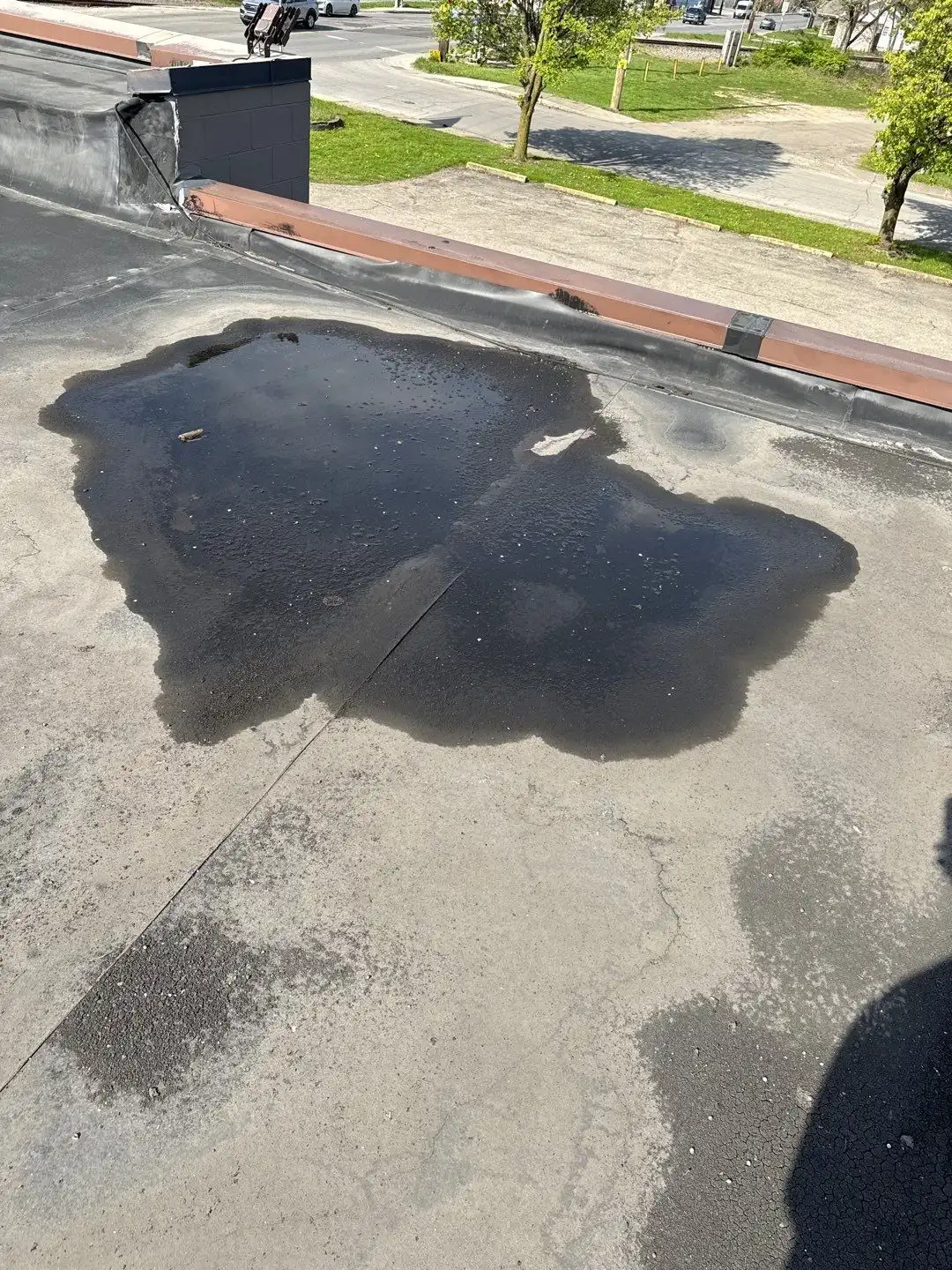
- Ponding water: Low spots where standing water degrades the membrane.
- Edge metal and drains: Failed termination bars, loose coping, clogged scuppers.
A few less obvious culprits also show up on Rushville roofs:
- Pitch pockets: The sealant inside pitch pans shrinks and cracks, letting water travel down conduit or strut legs.
- Wall counterflashing: Reglets pull loose from masonry as the building moves with seasonal temperature swings.
- Solar and antenna mounts: Anything added after the roof was installed is a high risk penetration unless flashed by a roofer.
- Skylight curbs: The membrane termination at the curb base often outlives the skylight gasket above it.
2. Leak Detection Methods We Use
You cannot fix what you have not located. Here is the order of operations on a typical service call.
- Interior mapping: Mark every wet spot, then measure to the nearest exterior wall to project the location onto the roof.
- Visual roof walk: Inspect seams, flashings, drains, and penetrations within a generous radius of the projected point.
- Moisture meter scan: Check insulation saturation through the membrane to trace water travel.
- Infrared imaging: Thermal cameras reveal wet insulation hours after sunset when the deck releases heat unevenly.
- Flood or spray test: Controlled water application to suspect areas while a spotter watches the interior.
- Core sample (if needed): A small cut confirms wet insulation and tells us how far the damage has traveled.
Water rarely enters where it appears inside. On a flat roof with tapered insulation, a breach near an HVAC curb can show up 30 feet away at a recessed light. That is why Rushville Commercial Roofing maps both sides of the assembly before opening anything up.
For interior water that has already reached drywall or ceiling tile, pair the roof investigation with our notes on attic water damage from roof leaks so nothing gets missed inside the envelope.
3. What Detection Costs in Rushville
Basic visual inspections are typically included with a repair quote. Diagnostic work scales with complexity.
6. Repair Cost Ranges in Rushville
Pricing depends on access, membrane type, and how much insulation is wet. Typical brackets:
- Single penetration reseal: $350 to $750.
- Seam repair, under 10 linear feet: $500 to $1,200.
- Patch with wet insulation replacement: $1,200 to $3,500.
- Drain or scupper rebuild: $800 to $2,400.
- Section recoating (200 to 500 sq ft): $1,800 to $4,500.
Factors that push pricing toward the high end:
- Crane or lift access on tall commercial buildings.
- Multiple membrane layers from prior overlays that must be cut through.
- Asbestos containing felts on older BUR systems (requires testing and abatement).
- After hours work on retail or medical facilities that cannot tolerate daytime disruption.
5. What a Real Repair Visit Looks Like
Honest repair work follows a sequence. Skipping steps is how leaks come back.
- Severity assessed over the phone so we bring the right materials.
- Active leaks are tarped or dried in first to stop interior damage.
- Detection completed and the actual breach is marked.
- Wet insulation is removed and replaced where deck moisture is confirmed.
- Membrane is cleaned, primed, and patched per manufacturer specs.
- Repair is water tested before crews leave.
- Written report with photos goes to you and, if applicable, your insurance adjuster.
9. What to Do Before We Arrive
If water is actively entering the building:
- Move electronics, inventory, and documents out from under the drip line.
- Place buckets and lay towels, but do not climb the roof in wet conditions.
- Punch a small relief hole in a bulging ceiling to release trapped water into a container.
- Shut off power to affected fixtures at the breaker.
- Photograph everything before you move it.
For commercial tenants, also notify your property manager in writing and keep a copy. Many lease agreements require written notice for the landlord to be on the hook for repairs, and a quick email timestamp can save weeks of back and forth later.
If the leak has been ongoing, check our overview of signs of hidden water damage so you know what else to inspect.
7. When Repair Stops Making Sense
Spot repairs buy time. They do not reverse age. Consider replacement or full restoration when:
- The roof has more than three active leak locations.
- Wet insulation covers more than 25 percent of the field.
- Membrane is brittle, cracking widely, or losing adhesion in sheets.
- You have already paid for three or more repairs in 24 months.
- Ponding water covers large areas more than 48 hours after rain.
A fluid applied restoration coating is often the middle path. If the membrane is sound but tired, a reinforced silicone or acrylic system can add 10 to 15 years at roughly half the cost of tear off. Rushville Commercial Roofing runs a moisture survey first so wet insulation is not buried under a new coating.
8. Insurance and Documentation
Storm related damage in Rushville is often covered. Wear and tear is not. To give your claim its best chance:
- Photograph the interior damage immediately, before any cleanup.
- Save the dated weather event (hail, high wind) that preceded the leak.
- Request a written report with roof photos, moisture readings, and cause of loss language.
- Pair roof repair documentation with interior ceiling water damage restoration records so the claim is complete.
4. Repair Approach by Membrane Type
Not every flat roof gets the same fix. Match the repair to the material.
- TPO and PVC: Heat welded patches over cleaned membrane. Mechanical fastener replacement at failed seams. Reinforced flashing at penetrations.
- EPDM (rubber): Primer plus uncured rubber flashing or seam tape. Liquid sealant only as a temporary measure.
- Modified bitumen: Torch down or peel and stick patches. Granule replenishment on cap sheets.
- Built up roofing (BUR): Cold process patches, fiberglass reinforcement, new flood coat on isolated areas.
- Coatings (acrylic, silicone): Recoat after cleaning and reinforcing fabric over cracks.
A few cross cutting rules apply regardless of membrane:
- Patches should extend at least 4 to 6 inches past the visible damage in every direction.
- Substrate has to be dry and clean. Dirt or moisture under a patch is a future leak.
- Sealant alone is never a finished repair on a horizontal surface.
- Compatible materials only. PVC patches do not bond to TPO, and silicone coatings reject most overlay materials later.
10. Questions to Ask Any Flat Roof Contractor
- Will you locate the actual leak source, not just patch the visible stain area?
- Do you replace wet insulation, or only the membrane on top?
- What warranty applies to the repair, and is it in writing?
- Will you provide photos before, during, and after?
- If repair is not the right call, will you say so?
- Are your crews trained on the specific membrane on my building?
- Can you provide references from similar Rushville properties?
Straight answers to those questions tell you more than any sales pitch. Rushville Commercial Roofing would rather lose a job to a better fit contractor than sell a repair that will not hold.